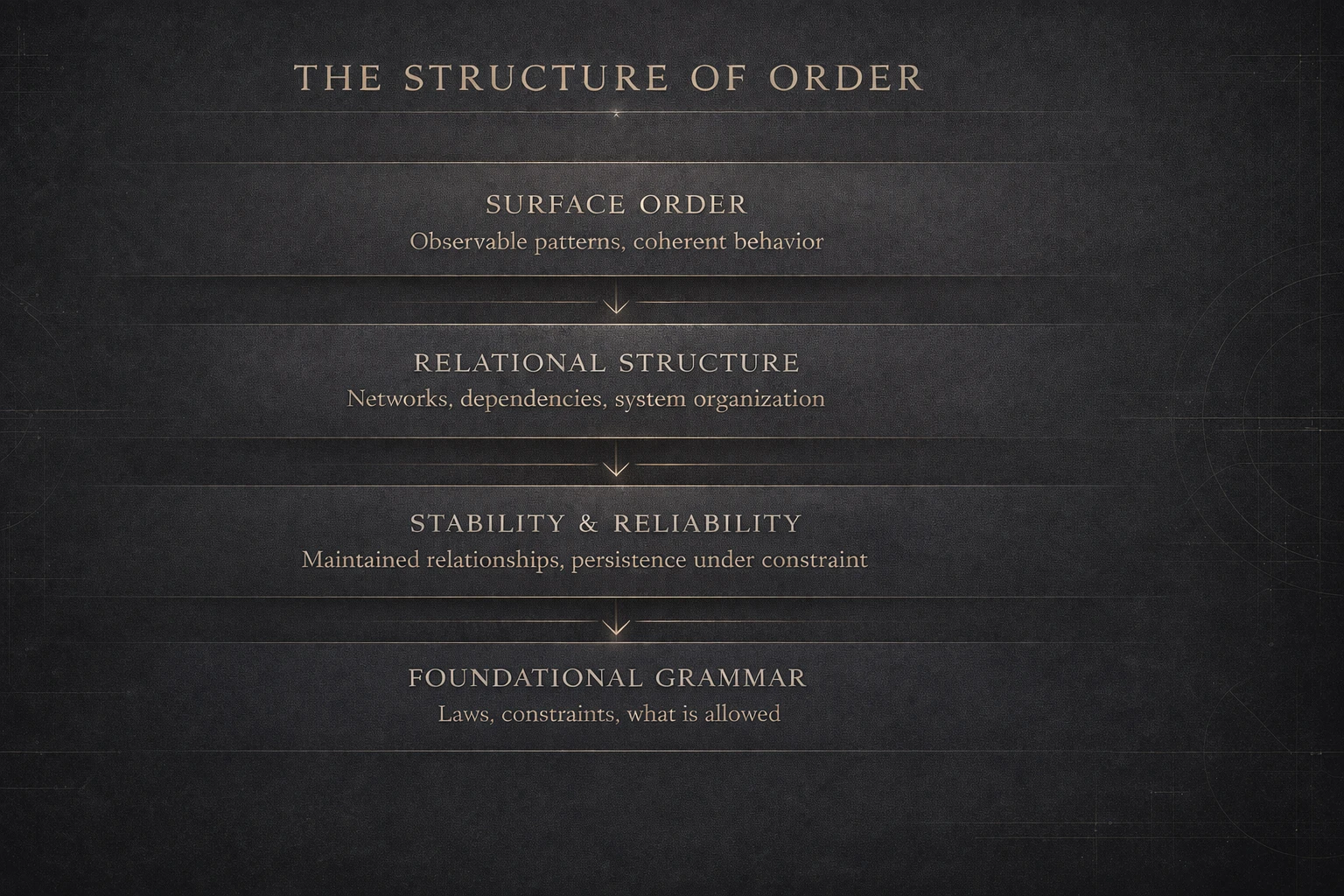
Core Claim
All durable human systems are structured across three non-substitutable layers:
Relational Order
trust • reciprocity • costly commitment
This is the deepest diagnostic and least mechanizable layer. It concerns the quality of relationships, the credibility of commitments, and the degree to which actors can coordinate without constant force or surveillance.
Provision
distribution • services • institutional support
This layer includes the material and institutional means by which a system sustains participation: infrastructure, opportunity, services, access, and the distribution of stabilizing goods.
Constraint
rights • law • limits on coercion
This layer defines boundaries, rules, and enforceable limits. It restrains predation, establishes legal standing, and creates the floor beneath which a system cannot remain ordered.
Anchor Principle: Stability does not come from maximizing any one layer. It comes from maintaining alignment between them.
Why the Layers Matter
Many modern arguments about politics, institutions, and social breakdown collapse these layers into one another. Some assume law can manufacture trust. Others assume provision can substitute for legitimacy. Still others assume freedom from interference is enough to generate durable coherence on its own.
This framework begins from a different premise: each layer performs a different kind of work, and none can permanently substitute for the others.
Order fails not only when rules are absent or resources are scarce, but when the wrong layer is asked to do the wrong kind of work.
What the Framework Does
Diagnostic
It helps identify whether a visible problem is primarily a failure of constraint, provision, or relational order.
Discriminating
It exposes substitution errors—for example, when institutions attempt to engineer trust through mechanisms better suited to law or distribution.
Orienting
It clarifies sequence: which layer is under greatest strain, which response buys time, and which type of repair is actually possible.
Non-polemical
It does not begin with party or ideology. It begins with structure, asking how a system is carrying—or failing to carry—the burden of order.
What the Framework Does Not Do
The Relational Architecture of Order is not a policy engine and does not yield a ready-made political program. It does something prior to prescription. It helps distinguish between failures of law, failures of provision, and failures of relational coherence so that proposed responses can be judged by whether they are operating in the right layer of the system.
Important Limitation: The framework does not directly answer, “What is to be done?” It clarifies what kind of work needs to be done, where the strain lies, and which responses are likely to be mismatched.
How This Connects to the Wider Project
This grammar is not limited to civic life. It is meant to illuminate recurring patterns across domains: biochemistry, neural systems, social institutions, geopolitics, and AI. The same question can be asked in each case: what are the constraints, what provides stability, and what relational architecture allows the system to function as a coherent whole?
That is why the next essay in the current sequence can move into biochemistry without abandoning this framework. The grammar is meant to scale across domains, not remain confined to political analysis.
Case Studies
The following case studies serve as reference points. They are not exhaustive histories. They are structured demonstrations of how the grammar can be applied to visible conflict, institutional reform, and long-run systemic stability.
The Civil Rights Era and the Layers of Order
A primary case study showing how visible conflict can expose deep misalignment between law, provision, and relational legitimacy within a single society.
Open case study →
The Post-War Order and the Architecture of Stability
A witness case demonstrating how large-scale geopolitical stability depends on the alignment of deterrence, material support, and shared institutional trust.
Open case study →
Working Thesis
Constraint can stabilize the floor of a system. Provision can sustain participation within it. But the highest forms of durable order are carried relationally. Where that layer weakens, systems increasingly depend on force, incentives, and administrative complexity to produce outcomes that once arose more organically.
Central Thesis: Order is not singular. It is layered. And the most load-bearing forms of coherence cannot be fully manufactured through mechanism alone.