Entangled Reality • Atlas

The Intellectual Atlas

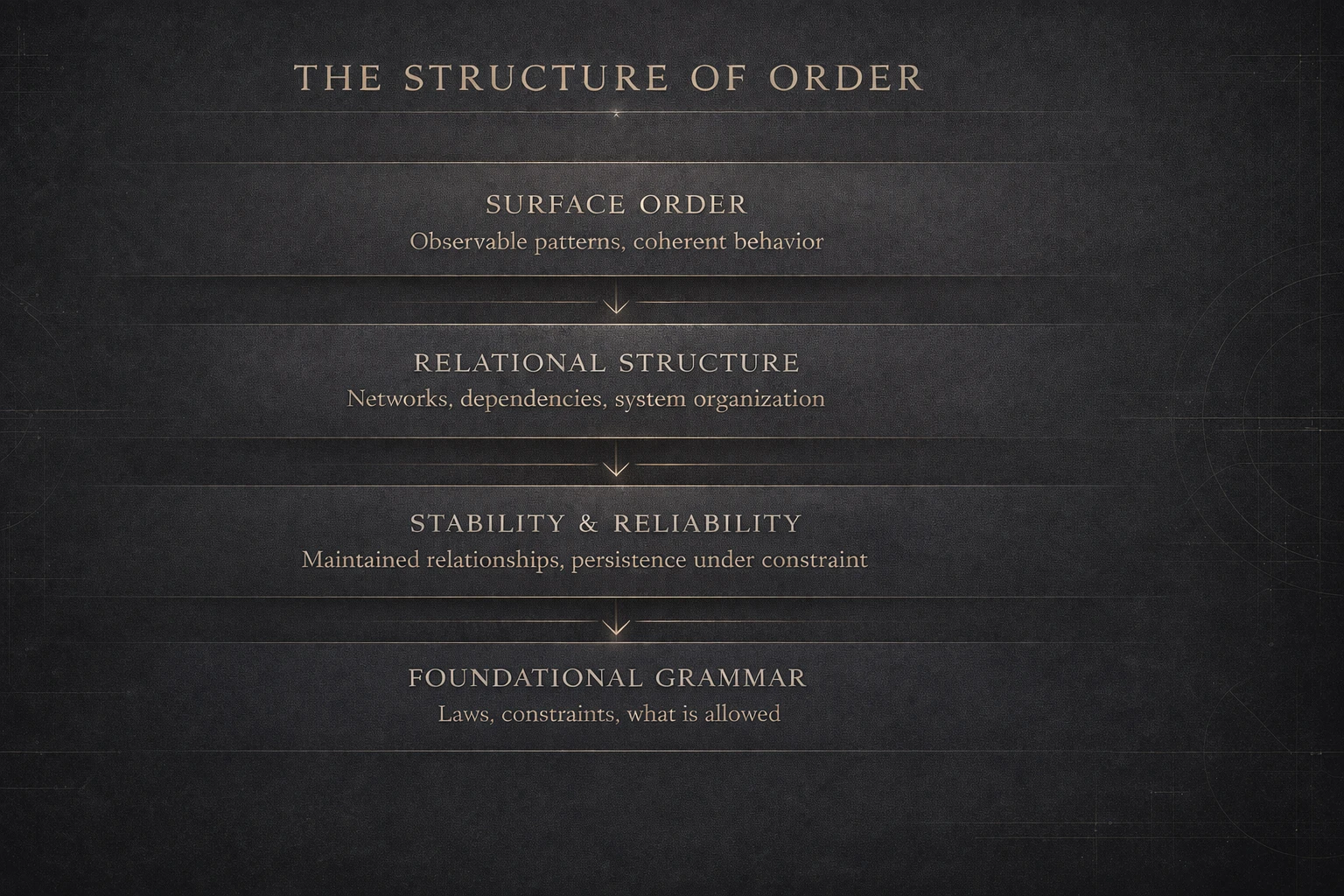
A conceptual map of the project’s central claim: durable order is not singular. It is layered across constraint, provision, and relational order. These layers are distinct, interdependent, and non-substitutable.

The Structure of Order: a three-layer framework showing Relational Order, Provision, and Constraint
The Relational Architecture of Order: constraint establishes limits on coercion, provision sustains participation, and relational order binds the whole through trust, reciprocity, and costly commitment.

In this diagram, “top” does not mean superficial. Relational Order appears at the top because it is the highest-order integration of the system—the level where constraint and provision become coherent through trust, reciprocity, and costly commitment. It is also the deepest diagnostic layer: the least visible, hardest to manufacture, and most decisive when systems come under strain.

What this page is for

This page serves as the conceptual center of Entangled Reality. It is not an essay and not a domain-specific argument. It is the site’s orienting map: a place to locate the grammar of order before following it into physics, biochemistry, society, artificial intelligence, and historical case studies.

The framework does not reduce every domain to politics, biology, or mechanism. It asks a recurring structural question: what constrains the system, what sustains it, and what relational architecture allows it to function as a coherent whole?

The Three Layers

Each layer performs a different kind of work. The model becomes useful precisely because the layers cannot be collapsed into one another.

Layer 1

Constraint

The boundary structure that limits coercion and establishes the conditions under which ordered life can proceed.

  • law and rights
  • limits on predation
  • formal boundaries
  • enforceable obligations

Constraint stabilizes the floor of order. Without it, systems fragment into arbitrary force, insecurity, or domination.

Layer 2

Provision

The material and institutional support by which a system sustains participation across time.

  • distribution and services
  • infrastructure
  • institutional support
  • shared material stability

Provision makes participation livable. But provision alone cannot create legitimacy, trust, or durable coherence.

Layer 3

Relational Order

The trust-bearing architecture through which people, institutions, and systems coordinate without constant force.

  • trust and reciprocity
  • costly commitment
  • legitimacy
  • shared expectations

Relational order is the highest-order integration of the system and the deepest diagnostic layer when order comes under strain.

The point is not that one layer is “good” and another is “bad.” All three are necessary. Disorder often emerges when one layer is forced to do the work of another: when law is asked to manufacture trust, when provision substitutes for legitimacy, or when relational appeals are used where constraint has failed.

How the framework applies across domains

The atlas traces a recurring pattern: durable order depends on constraint, sustained support, and relational integration. The form changes across domains, but the grammar recurs.

Physics

Physical systems are bounded by lawful constraint, but stable form depends on which configurations can persist and interact coherently across time.

Biochemistry

Chemistry makes reactions possible, but living systems depend on reliable relational machinery: enzymes, translation systems, proofreading, regulation, and coordinated flow.

Neural Systems

Intelligence does not arise from isolated units alone, but from weighted, maintained, dynamically stable relations across a network.

Family / Society

Social order is not merely rule declaration or material provision. It depends on trust, role fidelity, reciprocal reliability, and commitments that hold under strain.

Artificial Intelligence

Capability alone is not order. A durable AI order requires constraints, reliable operation, bounded roles, and alignment that remains stable under pressure.

Historical Case Studies

The case studies show how the grammar can be used diagnostically, without collapsing into polemic: identifying which layer is under strain and which responses are mismatched.
This atlas will continue to expand. Over time, it should become the site’s central conceptual reference point: a place where readers can orient themselves before descending into more detailed essays, diagrams, case studies, and domain-specific arguments.