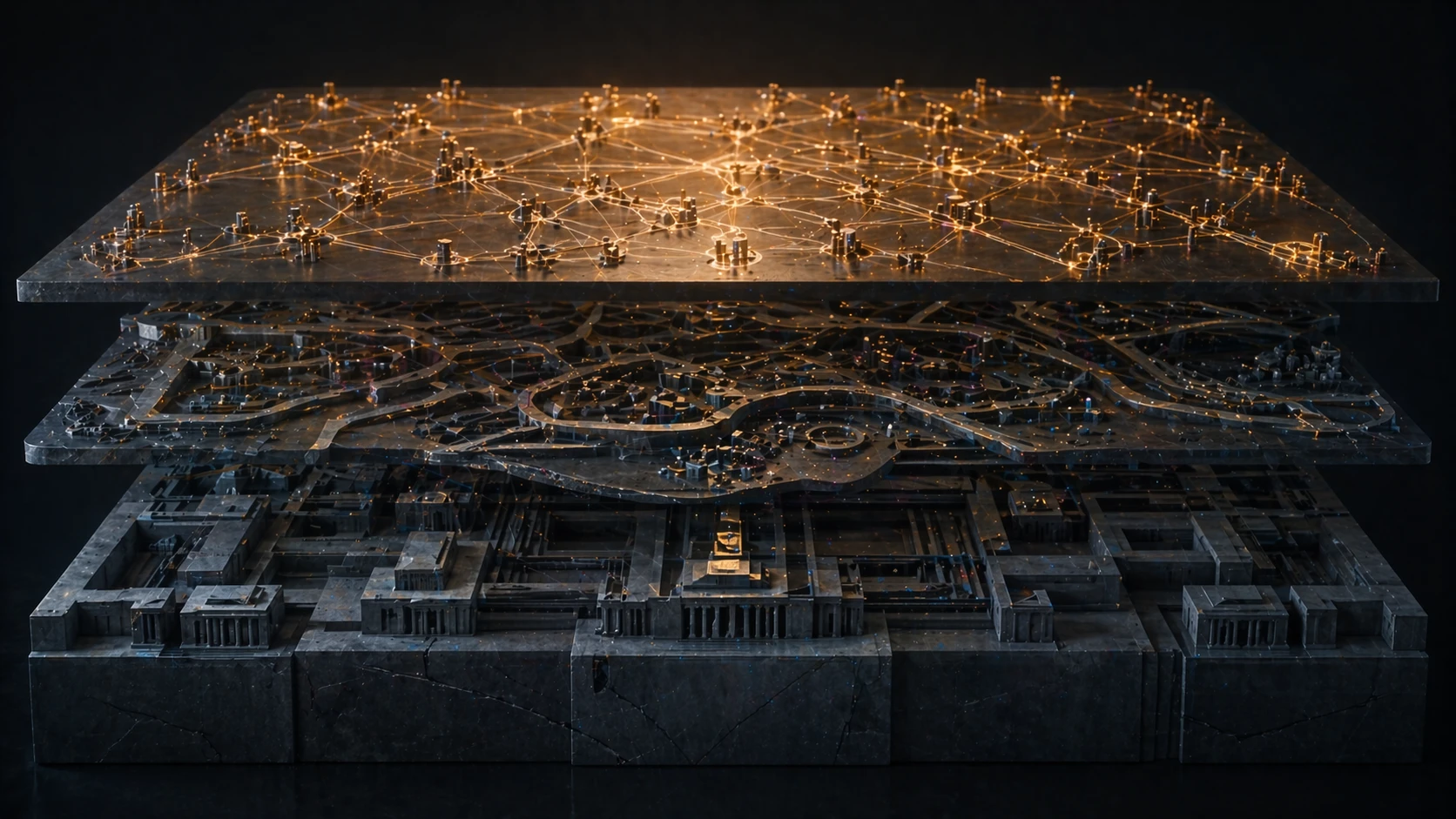
Visible Order
The post-war order was marked by relative peace among major powers, expanding trade, long-run economic growth, and a dense network of institutions and alliances. It appeared stable not because conflict had vanished, but because deeper layers were aligned well enough to keep disorder from becoming dominant.
Framework Insight: Visible stability is often the surface expression of multiple layers working in concert, not the product of a single institution or policy.
Constraint
The post-war order rested on a strong constraint layer. Military deterrence, alliance commitments, security guarantees, and defined red lines created a framework in which escalation carried real consequences.
- Defense alliances increased predictability and distributed risk.
- Deterrence limited certain forms of direct great-power conflict.
- Institutional agreements helped formalize expectations and boundaries.
Constraint did not eliminate rivalry. It made rivalry more governable by reducing ambiguity around force, obligation, and consequence.
Provision
The provision layer was equally important. Post-war reconstruction, trade expansion, financial architecture, industrial growth, and shared economic incentives made cooperation materially rewarding.
- Economic interdependence lowered the immediate incentive for rupture among aligned states.
- Institutional coordination supported recovery, liquidity, and long-term planning.
- Growth created social and political space for broader stability.
Provision made the order livable. Constraint defined limits. Together they gave the system its visible durability.
Key Point: Stable order often depends not only on what actors fear, but on what they stand to lose by defecting.
Relational Order
The deepest layer involved trust, legitimacy, and shared expectations among cooperating states. This did not mean total agreement or moral harmony. It meant enough alignment of outlook, enough confidence in mutual commitment, and enough continuity of expectation to reduce the need for constant coercion.
- Institutions were not merely formal; they were backed by real confidence in ongoing participation.
- Allied cooperation depended on more than treaties—it depended on expectations of reliability.
- Shared narratives of order, reconstruction, and mutual security helped carry the system.
This layer is easy to overlook precisely because it makes large systems feel natural while it is intact.
How the Alignment Worked
Constraint
Provided boundaries, deterrence, and a credible framework of consequence.
Provision
Created material incentives for continuity, coordination, and mutual benefit.
These layers were reinforced by relational order: trust in commitments, confidence in institutions, and a broad expectation that the system would continue. That expectation reduced friction and lowered the burden on coercion.
Constraint can restrain disorder. Provision can sustain participation. But the long life of a system depends on whether actors still believe the order is worth carrying together.
Gradual Strain
Over time, the post-war order has come under pressure. Interests diverge. Institutions fatigue. Internal polarization within states feeds external uncertainty. Shared narratives weaken. As relational confidence erodes, the system leans more heavily on incentives and enforcement to maintain the same outcomes.
- Constraint becomes more visibly burdensome.
- Provision becomes more contested and unevenly perceived.
- Relational trust declines beneath still-functioning institutions.
This does not mean the order disappears overnight. It means the system becomes more mechanical, more fragile, and more dependent on active maintenance.
Why This Case Matters
This witness case demonstrates that the same grammar visible in domestic social conflict also applies at civilizational and geopolitical scale. Stable order is not generated by force alone, nor by material provision alone. It depends on a layered alignment in which each level does different work and none can permanently substitute for the others.
Atlas Use: This case serves as a reference point for understanding why large systems can remain outwardly stable while quietly accumulating relational strain underneath.